Proteus P7R
One airframe.
Two domains.
Uncrewed vehicles that fly through the air and through the water, and cross between them on their own, as often as the mission needs.
Aircraft stop at the surface. Submarines stop at it too. The littoral lives on both sides of it. Proteus designs from physics up for air and water as one operating space. Not an aircraft that survives a dunk, not a submarine that can hop.
- 75km/h
- Air cruise
- 10m
- Maximum depth
- 7.5kg
- Take-off mass
- 0
- Parts swapped between media
The platform
P7R
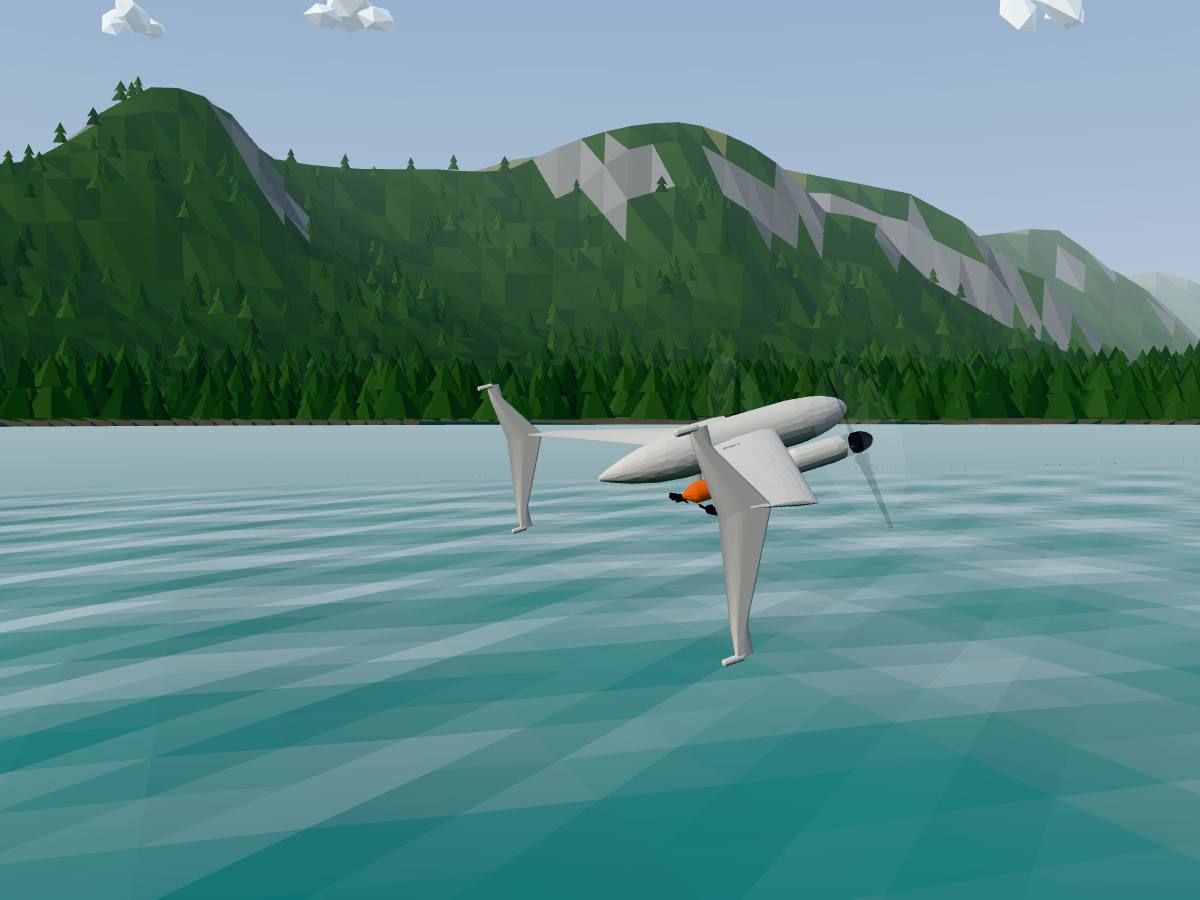
Flying-wing tailsitter. 1.59 m span, 7.5 kg. One airframe, no parts swapped.
Drag to inspect
Free-flooding wing, nacelles, pods and fins. Buoyancy comes only from two sealed dry boxes, closed-cell foam and potting.
Reference mission
A minute of hover costs more than five kilometres of cruise.
The mission P7R is sized against: leave the water, fly 5 km, hover, dive, travel 1 km below the surface, hold station at 5 m, swim up, fly home. The wing makes cruise cheap. The hover is what the battery is really for.
- Used
- 114 Wh
- Left at the end
- 56 Wh
- Under water, 1 km
- 11 Wh
From the P7R fast model with a 12 W hotel load (Prototype 1, no autonomy kit) and 4 % wiring and battery losses. At the full 40 W autonomy load the reserve drops to about 43 Wh.
Engineering
Generated, not drawn.
P7R is compiled from one parameter file into a native CAD model: every spar, seal, fastener and cable run. 2,259 build steps, 459 bodies. An automated gate checks geometry, mass and physics before anything reaches the workshop.
- 10,886,400
- architectures enumerated
- 621,774
- evaluated on physics
- 19,435
- feasible
- 1
- in the workshop
Every combination of how to lift, push, float, trim and cross the surface.
Mass, buoyancy, power and transition, screened automatically. Every rejection logged with its reason.
3.1 % close at screening level. Seven prototype generations narrowed them to one.
P7R v1.0. Carbon spars, printed lattice skins, parts you can buy today.
Simulation first
6-DOF hover dynamics, CFD on the released outer shell, modal FEA on the pod arms. Every figure on this page has a model behind it, and a test planned to check it.
Fail-safe by buoyancy
+2.9 % reserve in fresh water, +5.5 % in salt. Lose power at any depth and P7R floats to the surface on its own.
Buildable today
Purchased drives, a production Li-ion pack, carbon vacuum layup and 3D printing. No exotic materials, no single-source parts.
Applications
Where the sea meets the sky, most systems stop.
Transit fast on the wing, then go below the surface where radar and eyes cannot follow. Surface again when the picture is complete.
Hold position at zero speed against current to inspect hulls, piers, chains and intakes, without a boat or a diver.
Fly to a wind foundation or a cable landing, dive, inspect, surface and move to the next. One vehicle, one sortie.
Search wide from the air. Confirm below the surface without waiting for a second asset.
Specification
P7R v1.0 in numbers.
Airframe
- Configuration
- Flying-wing tailsitter
- Span
- 1,587 mm
- Length
- 832 mm
- Wing area / AR
- 0.317 m² / 7.8
- Airfoil
- Selig S5010, reflexed
- LE sweep / washout
- 22.6° / −11.9°
- Take-off mass
- 7.46 kg, design case
Air
- Air units
- 2 × T-Motor V505 KV260
- Propellers
- 18×11 carbon folding, Ø457 mm
- Cruise
- 75 km/h
- Efficiency
- 3.4 to 4.4 Wh/km (model)
- Air range
- about 44 km (model)
- Hover
- Tailsitter, 60 s required
Water
- Water units
- 2 × flooded direct-drive pods
- Vectoring
- ±35° pitch per pod
- Top speed
- about 3.2 m/s (model)
- Depth
- 5 m design, 10 m max
- Buoyancy reserve
- +2.9 % fresh, +5.5 % salt
- Fail-safe
- Floats up on power loss
System
- Battery
- Amprius SA504, 12S Li-ion
- Dry volume
- 2 sealed boxes, rated 1.5 bar
- Structure
- CFRP spars, printed lattice skins
- Landing
- Fin-legs, 4 sprung feet
- Control
- RC and tether (P1), autonomy-ready
- CAD
- 459 bodies, gate 28 / 28
Where we are
From ten million ideas to one airframe.
- Concept · Done
10.9 M architectures enumerated
Every combination of lift, thrust, buoyancy and transition principle, screened on physics rather than precedent.
- Design · Done
Seven prototype generations
P1 to P7, each kept or killed on the numbers. P7R is the clean-sheet redesign that closes in mass, buoyancy and hover.
- Build · Now
Prototype 1 in the workshop
The released v1.0 model: carbon spars, printed lattice skins, purchased drives. Thrust stand and tank tests first.
- Test · Next
Hover, entry, exit
Tethered hover over land, tail-first entry, swim-up exit in sea state 1 to 2.
- Autonomy · Next
One stack, two media
Jetson-class computer, DVL and sonar under water, GNSS in the air.